
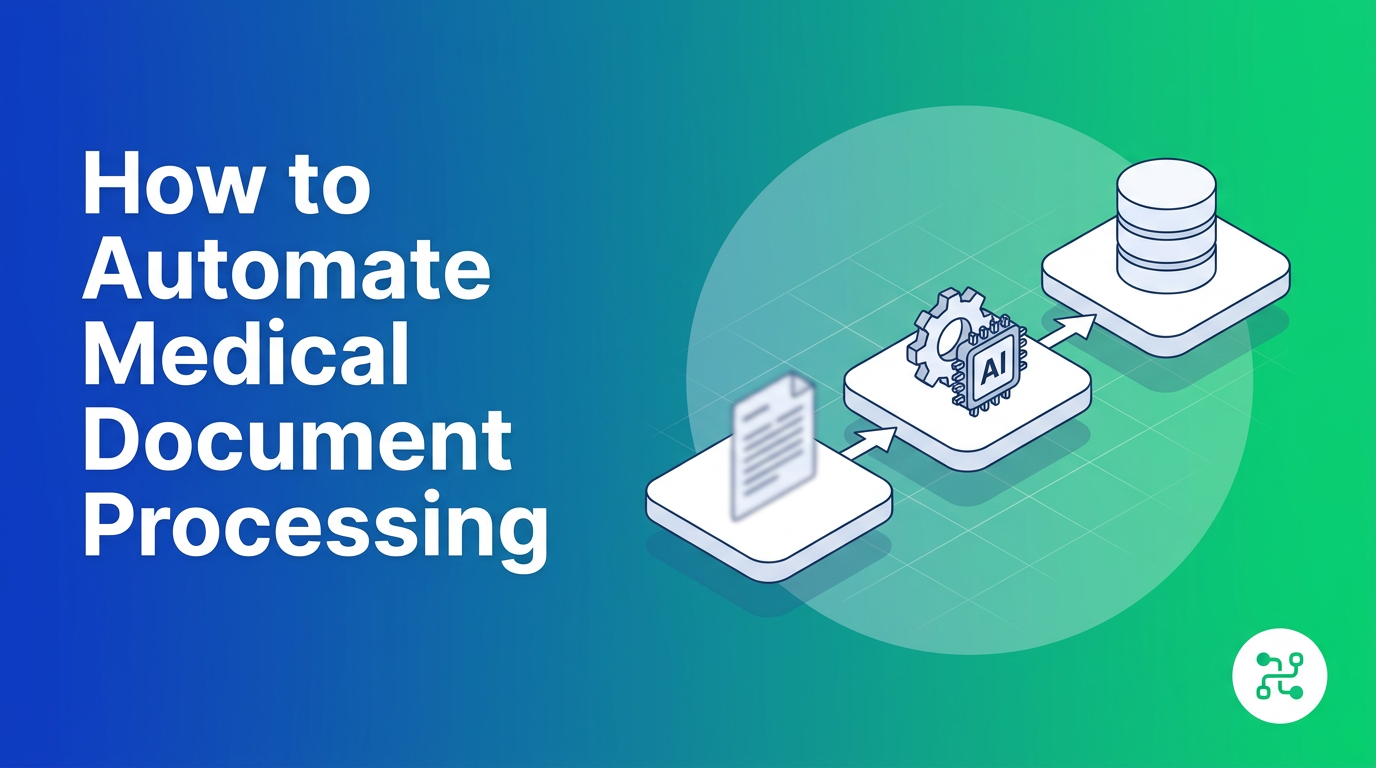
How to Automate Medical Document Processing: A Practical Guide for Healthcare Operations Teams
Automating medical document processing reduces manual data entry, eliminates filing errors, and accelerates patient workflows. This guide covers how to do it, which documents to start with, and what results look like in practice.
Medical document processing is one of the largest sources of manual administrative work in healthcare. Patient intake packets, clinical notes, referral forms, lab reports, discharge summaries, medication lists — each one requires someone to read it, interpret it, and enter the relevant information into a system somewhere.
That work is expensive, error-prone, and difficult to scale. FormX.ai is the platform healthcare teams use to automate it. This guide explains how medical document processing automation works, which document types benefit most, and what the implementation actually looks like. For the full picture of what’s available out of the box, see FormX.ai’s healthcare document processing platform.
Why Medical Document Processing Is Hard to Automate (and Why That’s Changed)
For a long time, automating document processing in healthcare meant one of two things: deploying expensive custom integrations that required months of configuration, or using basic OCR tools that worked fine on clean, structured forms but fell apart on anything handwritten, faxed, or unstructured.
Neither option worked well for the reality of healthcare documents — which are inconsistent in format, often arrive via fax, and frequently contain critical information in unstructured free text that a basic OCR pass can’t interpret.
What’s changed is the intelligence layer. FormX.ai combines OCR (for text recognition), AI (for understanding context and document structure), and machine learning models trained on healthcare-specific document types. The result is a system that handles the messy reality of actual healthcare documents — not just clean PDFs in a controlled test.
The Document Types That Benefit Most from Automation
Not every document needs the same automation approach. Prioritize by volume and business impact:
High-volume, high-structure documents (start here)
Patient intake forms — demographic data, insurance IDs, medical history, allergies, current medications. High volume, relatively consistent layout, significant time sink for front-office staff. FormX.ai handles these with the shortest implementation time of any document type.
Insurance and EOB documents — procedure codes, payment amounts, denial reasons, patient responsibility. FormX.ai feeds structured data directly into your billing system, accelerating revenue cycle velocity.
Prescription forms — drug name, dosage, frequency, refills, prescribing physician. Whether received as PDF, fax, or scanned paper, FormX.ai’s consistent field extraction handles the full range.
Medium-volume, variable-format documents (second priority)
Referral forms — these arrive from multiple providers with different layouts. FormX.ai works by document semantics, not fixed templates, so it handles variation without manual configuration per sender.
Laboratory reports — semi-structured PDFs from lab systems. FormX.ai extracts consistent logical fields (test name, result, reference range, collection date) regardless of visual formatting differences across lab providers.
Lower-volume, high-complexity documents (LLM-based extraction)
Clinical notes and physician documentation — unstructured free text with abbreviations, medical shorthand, dictated content. FormX.ai uses LLM-based extraction on top of OCR to pull diagnoses, medications, procedures, and follow-up plans from prose rather than structured fields.
Discharge summaries — multi-page, semi-structured with critical clinical and transitional care information. High downstream impact; FormX.ai’s LLM extraction handles the variability across different clinical documentation styles.
How FormX.ai’s Automation Works End-to-End
FormX.ai’s automated medical document processing workflow has five components:
1. Ingestion
Documents enter from any source — email attachment, fax-to-digital conversion, direct upload, integration with your existing document management system, or API from a partner system. FormX.ai accepts documents without requiring pre-sorting or manual routing.
2. Classification
Before extraction can happen, FormX.ai identifies what type of document it’s looking at. Is this a lab report, a referral form, or a medication list? Classification determines which extraction model to apply.
3. Data extraction
OCR converts image-based content to machine-readable text. FormX.ai’s AI layer then identifies fields, extracts values, handles multi-page logic, and resolves contextual ambiguity — knowing that “03/15” on a prescription is a date of service, not a patient’s birthday. For clinical notes, LLM-based extraction surfaces clinical entities from unstructured prose.
4. Validation
Extracted values are checked against expected patterns. Dates look like dates. NPI numbers match the NPI format. ICD-10 codes exist in the code set. FormX.ai flags values outside expected ranges for review rather than passing them through silently.
5. Delivery
FormX.ai pushes structured data directly into the destination system — EHR, billing platform, data warehouse — via API or webhook. No export-import cycle, no manual copy-paste step.
What Medical Record Digitization Enables Downstream
Automating the document processing workflow with FormX.ai is not just an efficiency measure — it unlocks capabilities that manual processing physically cannot support:
Real-time data availability
When a referral arrives and FormX.ai automatically extracts and enters it, the receiving team can act on it immediately. When a lab result processes automatically, the ordering physician sees it in the EHR without an intermediary step.
Cross-provider data aggregation
Post-discharge care providers, care coordination teams, and population health programs depend on aggregating data from multiple providers. FormX.ai’s automated extraction from incoming documents scales in a way that manual aggregation never can.
Audit trail and traceability
Every FormX.ai extraction creates a timestamped, traceable record: which document was processed, when, what was extracted, and what confidence level was assigned.
Error elimination at the source
Manual data entry errors — transposed digits, wrong patient matched to wrong chart, missed fields — happen at predictable rates. FormX.ai’s field-level validation eliminates the most common error categories before data ever reaches the downstream system.
Real Results: 80% Reduction in Processing Time
A US-based post-discharge healthcare provider offers 24/7 phone and video support to help patients manage recovery plans, medication lists, and urgent care needs. Their service model had already lowered patient readmission rates by 67% — but scaling was constrained by the volume of medical documents flowing through their operations.
Staff were manually copying patient data from referral forms, medical records, and medication lists into internal systems — a process that created delays, data entry errors, and a ceiling on how many patients the team could support.
After implementing FormX.ai, the organization reduced manual document processing time by 80%, cut data processing costs by 64%, and achieved 178% ROI.
“FormX.ai has reduced the time we spend on manual document processing by 80%. This has allowed us to allocate our resources more effectively and scale our operations while focusing on what matters most, providing the best care for our patients.” — Co-Founder, US Healthcare Provider
How to Get Started with FormX.ai
The right entry point for automation is the document type that creates the most friction in your current workflow. For most healthcare teams, that’s one of three places:
- Patient intake and registration — high volume, consistent format, immediate time savings measurable in staff hours per week
- Referral processing — cross-provider variability creates backlogs; FormX.ai absorbs volume spikes without adding headcount
- Post-discharge document management — medication lists, care summaries, follow-up instructions from multiple providers need to flow into a single system quickly
FormX.ai offers a free 100-page trial to test on your actual documents before any workflow change — no credit card required.
FormX.ai is an intelligent document processing platform for healthcare and regulated industries. ISO 27001, SOC 2 Type II compliant. Complies with the highest data privacy regulations.