
AI for Healthcare Document Processing: 5 Use Cases That Reduce Costs and Improve Patient Care
AI document processing is solving healthcare's biggest administrative bottlenecks. Here are 5 concrete use cases — with the results that follow when manual processing gets replaced with intelligent automation.
Healthcare organizations generate more documents than almost any other industry. Patient intake forms, referral packets, lab reports, clinical notes, discharge summaries, prior authorization requests, billing documents — the list is long and the volume doesn’t slow down.
Processing those documents manually creates delays, introduces errors, and consumes staff time that should go toward patients. FormX.ai is the platform healthcare teams use to replace manual processing — not by adding headcount, but by automating the most repetitive, highest-volume document workflows with measurable results. FormX.ai’s medical OCR solution is purpose-built for exactly this kind of automation.
Here are five use cases where FormX.ai is replacing manual document processing in healthcare today.
Why Document Processing Failures Are So Costly in Healthcare
Before the use cases, it’s worth naming what’s at stake:
Administrative delays cascade. When a referral takes two days to process manually, the patient waits two days to be scheduled. When a prior authorization form sits in a queue, the procedure gets delayed. Manual processing creates bottlenecks that affect care timing, not just operational efficiency.
One bad field is expensive. A transposed digit in a patient ID, a missed diagnosis code, an incorrectly entered medication dosage — data entry errors in healthcare aren’t just administrative problems. They create billing rejections, compliance exposure, and in clinical contexts, patient safety risk.
Regulatory requirements are demanding. Healthcare organizations operate under strict data accuracy and auditability requirements. Non-compliance carries financial and reputational risk, and manual processes make both harder to demonstrate.
FormX.ai addresses all three by automating extraction, validating data before it reaches downstream systems, and maintaining audit trails that compliance teams can actually use.
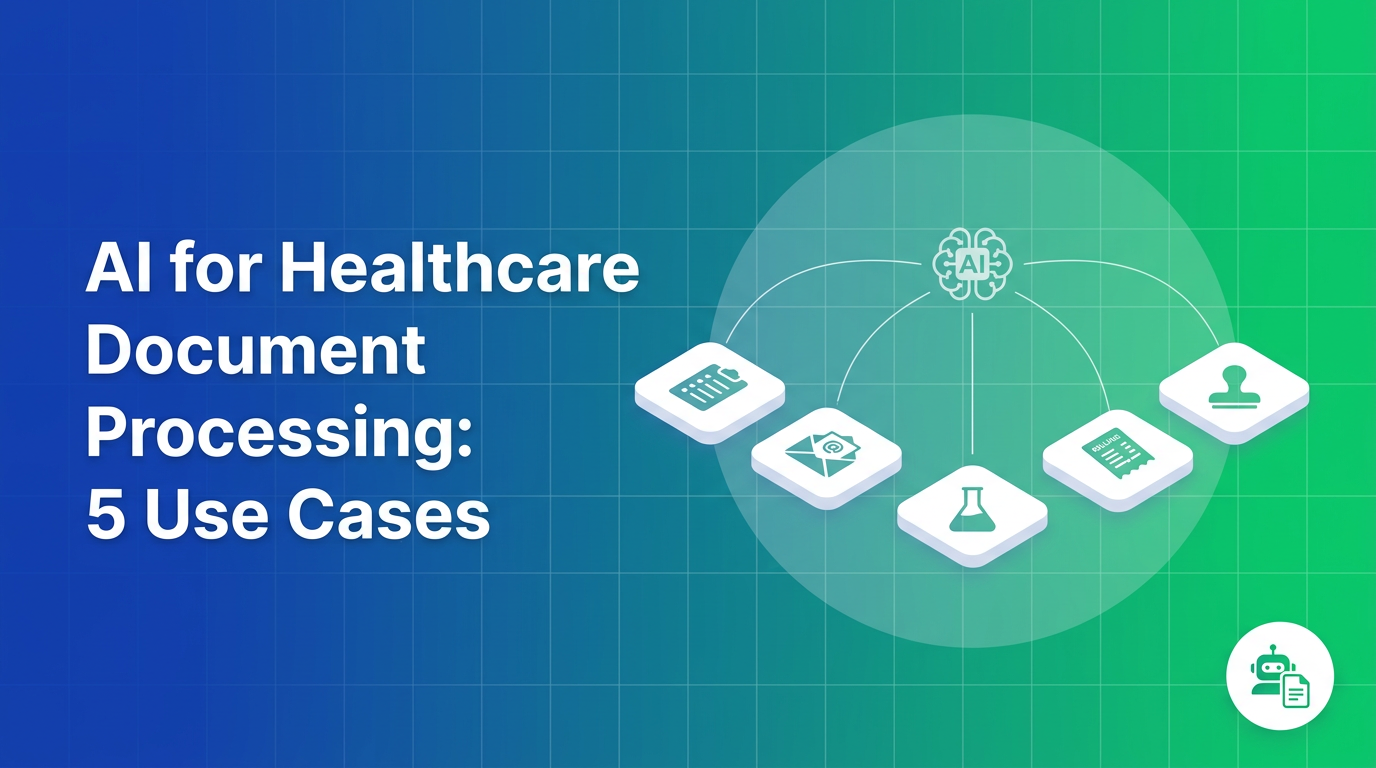
Use Case 1: Patient Intake and Registration Automation
The manual process: Patients complete paper intake forms or PDF packets. Front-office staff manually read the forms and enter demographic data, insurance information, medical history, allergies, and current medications into the EHR. For a busy practice, this is a continuous, high-volume task.
What FormX.ai does: Intake forms — whether handwritten, printed, or submitted as PDF — are automatically extracted. Patient name, date of birth, insurance ID, policy number, medical history, and medication list populate the EHR directly. Staff review is reserved for low-confidence extractions rather than every document.
The result: Front-office staff stop spending hours per day on data entry and redirect that time to patient interaction and scheduling. Data quality improves because FormX.ai’s field-level validation catches format errors (invalid insurance IDs, malformed dates) before they reach the EHR.
Document types FormX.ai handles: Patient intake forms, registration packets, insurance cards, consent forms.
Use Case 2: Referral and Authorization Processing
The manual process: Incoming referrals from other providers — often faxed — are printed, read, manually keyed into the scheduling or EHR system, and routed to the appropriate team. Each referral requires 10–15 minutes of staff time. Volume spikes create backlogs.
What FormX.ai does: Incoming fax-to-digital referral forms are automatically classified, extracted, and routed. Referring physician, patient ID, receiving specialist, diagnosis codes, insurance authorization, and clinical reason are pulled from the document regardless of which provider sent it or what their form layout looks like. Structured data lands in the scheduling system immediately.
The result: Referral processing time drops from 10–15 minutes per document to seconds. Backlogs clear. Patients are contacted faster after referral receipt, and care coordination timelines improve.
Document types FormX.ai handles: Referral forms, prior authorization requests, consultation requests, specialist intake packets.
Use Case 3: Lab Report Ingestion
The manual process: Lab results arrive as PDFs from multiple lab providers — Quest, LabCorp, hospital labs, specialty labs — each with a different format. Staff identify the ordering physician, find the patient record, match the lab to the right encounter, and enter key values. When lab results come in at volume, this is a significant processing burden.
What FormX.ai does: Lab report PDFs are automatically processed regardless of source format. FormX.ai extracts test name, result value, reference range, units, collection date, and ordering provider, and matches the data to the correct patient record and encounter. Results route to the ordering physician’s EHR view without a manual step.
The result: Lab result turnaround — the time between result receipt and ordering provider notification — collapses. Patient care is accelerated. Staff time on lab result processing is eliminated.
Document types FormX.ai handles: Lab reports, pathology reports, imaging result PDFs, diagnostic test results.
Use Case 4: Medical Records and Clinical Documentation Processing
The manual process: Patient records arrive from other providers as multi-page PDFs — clinical notes, discharge summaries, medication lists, care plans. Someone on the care team reads through them, extracts the relevant clinical details (current diagnoses, active medications, recent procedures, follow-up instructions), and enters them into the patient’s record in the receiving system.
What FormX.ai does: FormX.ai reads clinical documentation and uses LLM-based extraction to surface key structured data — diagnoses, medications, procedures, follow-up plan elements, care team contacts — from unstructured text. This works across different documentation styles, dictated notes, and EHR-generated summaries. Extracted data flows into the receiving system’s patient record, with the source document attached for clinical review.
The result: Care coordinators and clinical teams spend time reviewing and acting on patient information, not manually abstracting it. Post-discharge care programs that depend on processing incoming patient records can scale without adding manual labor.
Document types FormX.ai handles: Discharge summaries, clinical notes, care transition documents, continuity of care records, specialist consultation notes.
Use Case 5: Revenue Cycle and Billing Document Processing
The manual process: Claims, explanations of benefits (EOBs), and billing documents contain procedure codes, payment amounts, denial reasons, and patient responsibility amounts. Revenue cycle staff manually review and key these into billing systems. Errors in this process cause claim rejections, delayed reimbursements, and appeals cycles.
What FormX.ai does: Billing documents and EOBs are automatically extracted, with procedure codes, payer information, payment amounts, denial codes, and patient responsibility values delivered to the billing system in structured format. FormX.ai’s validation catches missing fields and format errors before submission — reducing denials at the front end rather than processing them after rejection.
The result: Revenue cycle velocity improves. Denial rates decrease. Staff time shifts from data entry to exception handling and appeals, where human judgment actually matters.
Document types FormX.ai handles: Medical billing documents, EOBs, claim forms, remittance advices, prior authorization confirmations.
What These Use Cases Have in Common
In each case, FormX.ai follows the same pattern:
- Documents arrive in whatever format they come — fax, PDF, scan, email attachment
- FormX.ai classifies and extracts — identifying document type, pulling field values, using LLM-based extraction for unstructured content
- Validation runs — field-level checks catch errors before data reaches downstream systems
- Structured data delivers — directly into EHR, billing system, or scheduling platform via API, with no manual import step
- Audit trail is maintained — every extraction timestamped, every source document preserved
The operational result is the same across use cases: staff time reclaimed from manual processing, error rates reduced at the source, data available faster for clinical and operational decisions.
Measured Results: FormX.ai in Healthcare
A US-based post-discharge healthcare provider implemented FormX.ai across their incoming document workflows — referral forms, medical records, and medication lists. Before automation, staff manually copied patient data from PDFs into internal systems throughout each day.
Results after implementing FormX.ai:
- 80% reduction in manual document processing time
- 64% reduction in data processing costs
- 178% ROI
“FormX.ai has reduced the time we spend on manual document processing by 80%. This has allowed us to allocate our resources more effectively and scale our operations while focusing on what matters most, providing the best care for our patients.” — Co-Founder, US Healthcare Provider
The same team had already reduced patient readmission rates by 67% through their care model. Removing the document processing bottleneck with FormX.ai allowed them to extend that model to more patients without a proportional increase in administrative headcount.
Why FormX.ai for Healthcare Document Processing
Data security and privacy compliance — FormX.ai maintains robust security measures against unauthorised access and does not use customer data for model training.
ISO 27001 and SOC 2 Type II compliance — Documented information security controls relevant for enterprise healthcare procurement.
LLM-based extraction for clinical text — FormX.ai handles unstructured physician notes, discharge summaries, and clinical documentation — not just structured forms.
Accuracy on your actual documents — Test FormX.ai on faxed referrals, handwritten forms, and multi-page PDFs from real sources. Start with a free 100-page trial — no credit card required.
API delivery — Structured data reaches your EHR, billing system, or database automatically. No manual import step.
Confidence scoring and human-in-the-loop review — Low-confidence extractions are flagged for review, not silently passed downstream.
FormX.ai is an intelligent document processing platform for healthcare and regulated industries. ISO 27001, SOC 2 Type II compliant. Complies with the highest data privacy regulations.