
Medical Form Data Extraction: How AI Pulls Structured Data from Patient Intake, Lab Reports, and Referral Forms
Manual data entry from medical forms costs healthcare teams thousands of hours. Here's how AI-powered medical form data extraction works — and how to automate it for intake forms, lab reports, and referral packets.
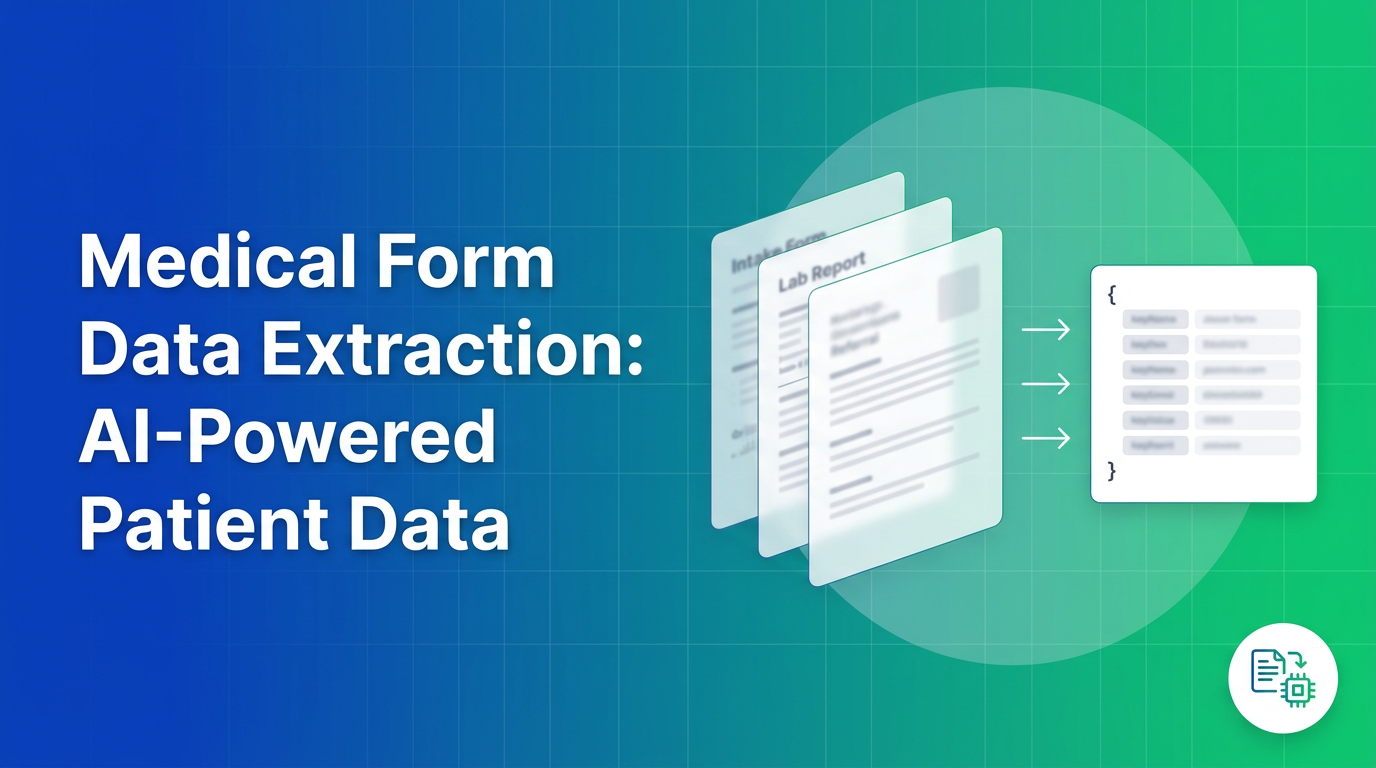
If your team is manually copying patient data from PDFs into your EHR, you already know the problem. A single referral packet takes 10–15 minutes to process by hand. Multiply that across hundreds of patients per week, add the inevitable transposition errors, and you have a process that’s expensive, slow, and fragile.
FormX.ai is built to replace that process. This guide covers how AI-powered medical form data extraction works, which form types benefit most, and what to look for in a solution. FormX.ai’s healthcare document processing platform covers each of these form types out of the box.
What Is Medical Form Data Extraction?
Medical form data extraction is the automated process of reading medical documents — whether printed forms, scanned PDFs, handwritten notes, or digital uploads — and pulling structured data from them into a usable format.
The output is not a copy of the document. It’s the actual field values: patient name, date of birth, diagnosis codes, medication names and dosages, test results, insurance identifiers, referring physician — each value mapped to the correct field, ready for your EHR, billing system, or data warehouse.
FormX.ai handles both structured forms (fixed-layout intake packets, standard lab report formats) and unstructured documents (clinical notes, discharge summaries, free-text physician observations) using machine learning trained specifically on healthcare document types.
The Five Medical Document Types That Drive the Most Extraction Work
1. Patient Intake Forms
The most common extraction target in outpatient and post-discharge settings. These include demographic data, insurance details, medical history, current medications, allergies, and reason for visit.
The extraction challenge: handwriting variance in open fields, checkbox ambiguity, and form layout differences across clinics or health systems. FormX.ai handles all of these without requiring a separate template per form variant.
The payoff: intake forms arrive in high volume on predictable schedules. FormX.ai automates extraction here and feeds clean data directly into downstream scheduling, billing, and clinical workflows.
2. Referral Forms
Cross-provider referrals contain referring physician, receiving specialist, patient ID, insurance authorization, diagnosis codes, and clinical reason. Layout varies by provider — a referral from a hospital system looks different from one sent by a private practice.
FormX.ai learns the semantics of referral documents, not just their layout, so it handles variation without requiring per-sender configuration.
3. Laboratory Reports
Lab reports are often semi-structured PDFs generated by lab systems. The fields are consistent (test name, result, reference range, units, collection date) but formatting differs significantly between Quest, LabCorp, hospital labs, and international providers.
FormX.ai maps the same logical fields across different visual formats without manual configuration per lab source.
4. Prescription Forms
Name, drug, dosage, frequency, refill count, prescribing physician, DEA number where applicable. The core fields are consistent but the layout ranges from preprinted pads to handwritten notes to electronic prescriptions exported as PDF. FormX.ai handles the full range.
5. Medical Records and Clinical Notes
The most complex category. Unstructured text — physician observations, dictated and transcribed summaries, discharge notes — contains critical clinical data but no fixed layout. FormX.ai uses LLM-based extraction to identify diagnoses, medications, procedures, follow-up instructions, and care plan details from prose, not just from structured fields.
How FormX.ai’s Extraction Pipeline Works
FormX.ai runs medical PDF extraction in four stages:
Step 1: Ingestion
Documents arrive as scanned images, uploaded PDFs, faxes, or files from an existing document management system. FormX.ai ingests them without manual pre-sorting.
Step 2: OCR (text layer)
Optical Character Recognition converts image-based documents — scans, photos, fax outputs — into machine-readable text. For digital-native PDFs, the text layer is extracted directly.
Step 3: AI field extraction
This is where standard OCR tools stop and FormX.ai’s intelligence begins. AI reads the document contextually, identifies which text belongs to which field, handles multi-page documents, and resolves ambiguity (e.g., a date that could be date of service or date of birth based on surrounding context). For unstructured clinical documents, LLM-based extraction identifies clinical entities from free text.
Step 4: Structured output and validation
Extracted values are validated against expected patterns — ICD-10 format, NPI number structure, date formatting — and delivered as JSON, CSV, or directly via API into your system of record.
What Extraction Accuracy Actually Looks Like
Published industry benchmarks for AI-based extraction vary by document type and quality:
- Printed, fixed-layout intake forms: 97–99% field-level accuracy
- Digital PDFs (lab reports, EOBs): 96–99%
- Scanned or faxed referrals: 88–95% depending on scan quality
- Handwritten fields in otherwise printed forms: 85–93%
- Unstructured clinical notes (LLM-based extraction): 90–96% for named entity extraction (medications, diagnoses, procedures)
The important metric is not character accuracy — it’s whether the correct value lands in the correct field. FormX.ai’s field-level validation (does this look like an NPI? Is this date within a plausible range?) catches the remaining errors before they reach your downstream system. Low-confidence extractions are flagged for human review rather than passed downstream silently.
The Cost of Not Automating Patient Data Extraction
The manual alternative has documented costs:
- Published research shows manual chart abstraction can take up to 30 minutes per patient case for basic chart reviews
- Data entry errors in manual processing create billing rejections, delayed claims, and EHR data quality issues that compound over time
- Staff assigned to data entry have capped throughput — volume spikes create backlogs that manual processes cannot absorb
One US-based post-discharge healthcare provider automated extraction of referral forms, medical records, and medication lists using FormX.ai. The result: 80% reduction in manual processing time, 64% reduction in data processing costs, and 178% ROI. The extraction that previously required staff to manually copy-paste from PDFs now completes automatically, with structured data flowing directly into their internal systems.
What to Look for in a Medical Form Data Extraction Tool
Handles your actual document mix
Test the tool on the documents you actually receive — not clean samples. If 30% of your referrals arrive by fax, your extraction tool needs to handle fax artifacts. FormX.ai can be tested on your own document types before any workflow commitment.
API-first output
Extraction that outputs a spreadsheet you import manually solves half the problem. FormX.ai delivers structured data directly to your EHR, billing system, or internal database via API or webhook.
Data security compliance
Verify the vendor’s security certifications and data handling practices before any patient data touches the platform. FormX.ai is ISO 27001 and SOC 2 Type II compliant and does not use customer data for model training.
Confidence scoring per field
FormX.ai flags low-confidence extractions for human review rather than silently passing bad data downstream — so you catch edge cases without reviewing every document.
Audit trail
Every FormX.ai extraction is fully traceable: source document, timestamp, extracted values, confidence scores, and any manual corrections made during review.
Where to Start with FormX.ai
Start with the document type that generates the most manual work for your team today. For most healthcare operations teams that’s one of:
- Patient intake forms — high volume, consistent format, immediate time savings
- Referral processing — cross-provider variability creates bottlenecks, automation has high business impact
- Lab result ingestion — semi-structured PDFs that still require manual review before clinical teams can act
FormX.ai offers a free 100-page trial — no credit card required — so you can verify extraction accuracy on your actual documents before changing any workflow.
FormX.ai is an intelligent document processing platform. ISO 27001, SOC 2 Type II compliant. Complies with the highest data privacy regulations. Start free with 100 pages — no credit card required.