
Medical Data Extraction: The Complete Guide for Healthcare Organizations
Medical data extraction converts clinical notes, lab reports, and scanned forms into structured, usable data. This complete guide covers extraction methods, accuracy expectations, and how AI transforms the process for healthcare teams.
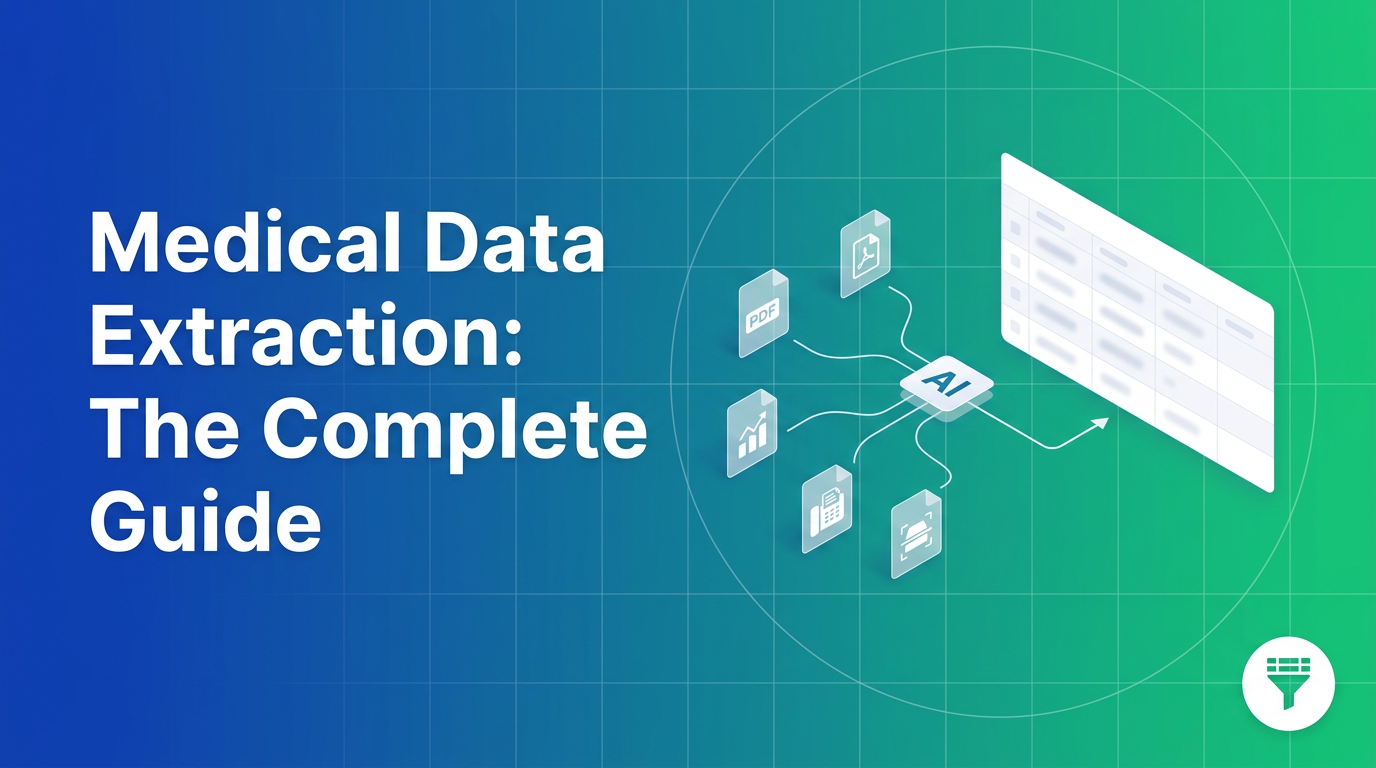
Medical data lives in the wrong places. It’s in PDFs your lab system generates, in scanned referral forms your fax machine receives, in physician notes that were dictated and transcribed, in paper charts that have never been touched by software. Getting that data out of those documents and into a format that systems can work with — that’s medical data extraction.
FormX.ai is purpose-built for this problem. This guide covers what medical data extraction is, the methods available, what each one is actually good for, and how AI has changed what’s achievable. FormX.ai’s medical OCR solution packages these methods into a single platform for healthcare teams.
What Is Medical Data Extraction?
Medical data extraction is the process of taking information from medical records, clinical documents, or healthcare data sources and converting it into structured, machine-readable format.
The output might be a structured JSON object with patient demographics, a CSV with lab results and reference ranges, or a database record with diagnosis codes and physician identifiers. The format varies by use case — what matters is that raw, locked-up information becomes actionable data.
This process matters across multiple parts of healthcare operations:
- Clinical research — extracting cohort data from charts without manual abstraction
- Quality improvement — identifying care gaps by pulling structured data from clinical documentation
- Revenue cycle — extracting billing codes and authorization details from documents that arrive as PDFs or faxes
- Population health — aggregating patient data across providers and document sources for program analytics
- Post-discharge care — processing incoming patient documents (referrals, medication lists, care summaries) quickly enough to act on them
FormX.ai handles all of these use cases across the full range of medical document types.
Methods of Medical Data Extraction
Manual Chart Abstraction
A trained clinical abstractor reads patient charts and enters key data into structured fields. This is the traditional approach and is considered the gold standard for accuracy on complex, subjective clinical data.
The cost is time. Published research shows manual chart review can take up to 30 minutes per patient case for a basic chart review. At scale — a quality improvement program reviewing 10,000 charts, a research registry pulling data from 50,000 encounters — manual abstraction is either prohibitively expensive or practically impossible.
Manual abstraction also has inter-rater variability: two reviewers reading the same note may categorize the same clinical event differently. That inconsistency is manageable with protocols and training, but it doesn’t disappear.
OCR (Optical Character Recognition)
OCR converts documents that exist as images — scanned paper forms, faxes, photographed charts — into machine-readable text. Once a document is text (rather than an image), software can search it, parse it, and extract specific values from it.
OCR is not extraction on its own — it’s the prerequisite step that makes extraction possible on paper-based or image-based documents. Published research has reported character-level accuracy above 97% for OCR-based medical text extraction from clean printed documents. Accuracy drops on handwriting, low-quality scans, and fax artifacts.
FormX.ai goes beyond basic character recognition. Its models are trained on medical document types — knowing that a prescription pad has a different field structure than a lab report, and that “QD” in a medication field means “once daily” rather than being an unknown string.
LLM-Based Extraction
Modern document extraction uses Large Language Models (LLMs) to understand the intent and meaning of text, not just identify characters or match keywords. This is particularly powerful for unstructured clinical documents.
In healthcare, LLM-based extraction is how you pull a diagnosis from a physician’s note that says “the patient presented with progressive shortness of breath over three weeks; chest X-ray findings consistent with bilateral pleural effusion” — extracting the clinical concept (pleural effusion), laterality (bilateral), and onset duration from prose that has no structured ICD-10 field.
FormX.ai uses LLM-based extraction for clinical notes, discharge summaries, and other unstructured documents where traditional pattern matching fails. Users describe what they want to extract in plain terms, and FormX.ai’s AI identifies and returns those values across variable document formats.
This approach is:
- Faster to deploy — no field mapping or template setup required per document type
- More consistent — same extraction logic applied uniformly across thousands of documents
- More adaptable — handles variation in documentation styles across providers and institutions
The critical constraint: LLMs cannot process patient data on public endpoints or through commercial API services that retain data for model training. FormX.ai operates under strict data handling policies that prevent patient data from being used to train models.
APIs
APIs don’t extract data — they move it. An API integration connects your extraction pipeline to your EHR, your research registry, or your billing platform, so that extracted data flows automatically into the right destination without a manual import step.
In a complete FormX.ai extraction workflow, APIs handle:
- Pulling source documents from EHR systems or document management platforms
- Delivering extracted structured data to the downstream database or application
- Triggering review workflows when extractions are flagged as low-confidence
How OCR, AI, and APIs Work Together in FormX.ai
Example: Post-discharge referral processing
- An API pulls incoming referral forms from the document management system as PDFs
- FormX.ai’s OCR converts scanned or faxed referrals into machine-readable text
- AI extracts patient ID, referring physician, diagnosis codes, insurance authorization, and clinical reason from each referral — regardless of which provider sent it or what their form looks like
- Extracted data is validated (ICD-10 codes match known codes; authorization number matches expected format)
- An API pushes structured data into the EHR patient record and triggers a care coordinator notification
This pipeline handles in seconds what a staff member would take 10–15 minutes to do manually.
Example: Research registry population
- An API pulls all relevant encounter notes from the EHR for a defined patient cohort
- FormX.ai’s OCR converts any scanned documents in those records to searchable text
- LLM-based extraction pulls specified clinical entities — diagnoses, medications, lab values, procedure dates — from the text
- Extracted data loads automatically into the research registry with source document links for auditing
This workflow replaces hundreds of hours of manual chart abstraction per research program.
What Accuracy to Expect by Document Type
Published industry benchmarks for AI-based medical data extraction:
| Document Type | Method | Expected Field-Level Accuracy |
|---|---|---|
| Printed, fixed-layout intake forms | OCR + template matching | 97–99% |
| Digital-native lab report PDFs | Direct text extraction + AI | 96–99% |
| Scanned referral forms (good quality) | OCR + AI | 92–96% |
| Faxed documents | OCR + AI + pre-processing | 85–93% |
| Handwritten fields in printed forms | OCR + handwriting AI | 85–92% |
| Unstructured clinical notes | LLM-based extraction | 90–96% |
Field-level accuracy matters more than character accuracy. A 99% character accuracy rate on a medication field can still produce “metformin 500m” instead of “metformin 500mg” — a difference that character-level scoring misses but FormX.ai’s field validation catches.
What Healthcare Teams Are Actually Extracting
The most common extraction targets FormX.ai handles in operational healthcare settings:
Patient demographics — name, DOB, address, insurance ID, emergency contact
Medication information — drug name, dosage, frequency, prescribing physician, refill count
Diagnosis codes — ICD-10 codes, associated diagnoses, primary vs. secondary classification
Lab values — test name, result, reference range, collection date, ordering provider
Procedure codes — CPT codes, service dates, performing provider
Insurance and authorization — payer, plan ID, authorization number, service authorization dates
Clinical concepts from notes — diagnoses, medications, procedures, allergies, care plan elements
Real Results: What FormX.ai Delivers at Scale
A US-based post-discharge healthcare provider processed hundreds of patient documents weekly — referral forms, medical records, and medication lists arriving as PDFs. Staff manually copied information from those documents into internal systems.
After implementing FormX.ai:
- Manual document processing time reduced by 80%
- Data processing costs reduced by 64%
- ROI of 178%
“FormX.ai has reduced the time we spend on manual document processing by 80%. This has allowed us to allocate our resources more effectively and scale our operations while focusing on what matters most, providing the best care for our patients.” — Co-Founder, US Healthcare Provider
The key was not just OCR. It was the full FormX.ai pipeline: OCR converting image documents to text, LLM-based AI extracting the right fields from variable document formats, and structured output flowing directly into the internal system without a manual import step.
Choosing a Medical Data Extraction Platform
The baseline checklist:
Data security and privacy compliance — Verify the vendor’s security certifications and data handling practices before any patient data touches the platform. Ask specifically about encryption, access controls, audit logging, and whether your data is used to train models.
ISO 27001 and SOC 2 Type II compliance — FormX.ai holds both, with documented information security controls relevant for enterprise healthcare procurement.
Handles your actual document mix — Test on faxed referrals, handwritten notes, and multi-page PDFs from your real document sources — not vendor-supplied samples. FormX.ai offers a free 100-page trial for exactly this.
Confidence scoring per field — FormX.ai flags low-confidence extractions for human review rather than silently passing bad data downstream.
API delivery to your destination system — FormX.ai delivers extracted data directly to your EHR, billing system, or data warehouse via API.
Full audit trail — Every FormX.ai extraction is timestamped, traceable to source document, with confidence scores preserved.
Start with 100 pages free — no credit card required.
FormX.ai is an intelligent document processing platform for healthcare and regulated industries. ISO 27001, SOC 2 Type II compliant. Complies with the highest data privacy regulations.
Latest articles